AI Adoption: The 0.04% Don't Know They're the 0.04%
2,500 dots on a grid. Each dot is roughly 3.2 million people. The whole grid is humanity.
84% of those dots are grey — people who have never touched AI. 16% are green — free chatbot users. About 0.3% pay for AI tools. And roughly 0.04% are using it for real workflows.
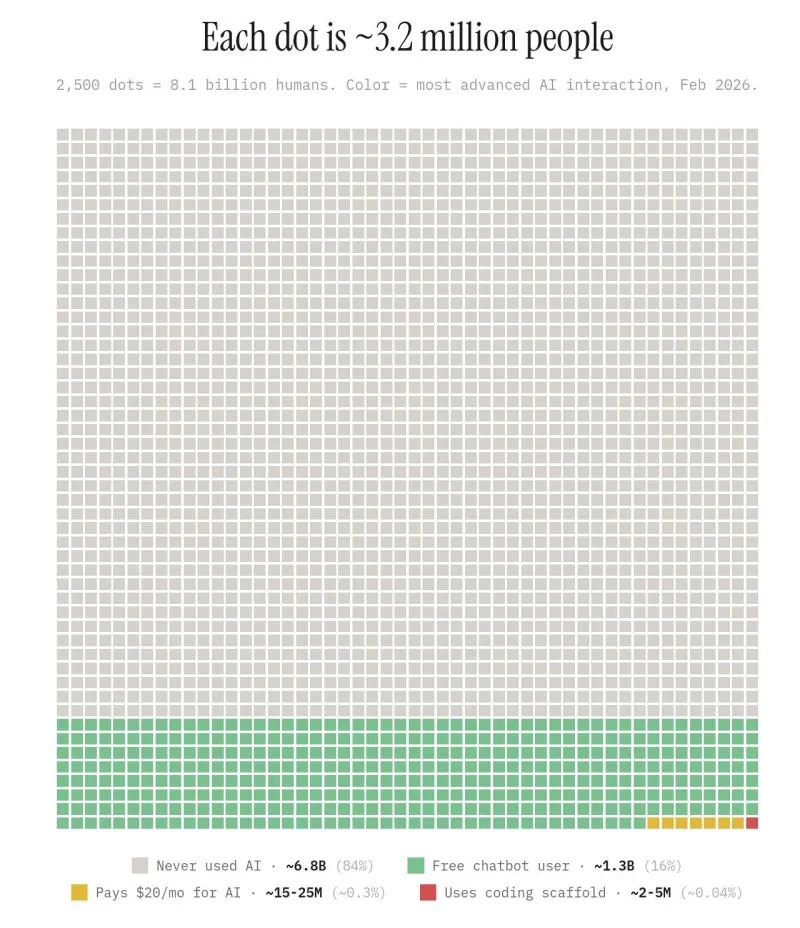
That’s a visualization Zach Dissington posted on LinkedIn, and his point was about market opportunity — the 8.1 billion denominator is wrong because it includes people without internet, without income, and without businesses. Strip those out and real SMB adoption is still under 0.5%. The field is empty, and whoever moves first owns it.
That’s a good point. But it’s not the one that got me.
The feed makes builders feel behind
I log into LinkedIn and feel behind on AI every single time. Not because I’m not using it — I build with it daily. My apps are built with it. This site is maintained by an AI agent I designed. I’ve shipped features, caught security issues, and managed sprint cycles with AI tools that most of the people posting about AI haven’t opened.
And I still close LinkedIn feeling like I missed something.
This isn’t just an anecdotal observation — more than one in nine adults report elevated anxiety about not keeping up with AI, and the phenomenon is acute enough that therapists are seeing it as a distinct category of workplace stress. Some workers are secretly adopting AI tools just to maintain perceived competitiveness — not because they need them, but because the anxiety of not using them has become its own pressure.
The LinkedIn AI discourse is populated disproportionately by people optimizing for the feed. These aren’t builders, they’re content creators. The people making you feel behind have figured out that “here’s what GPT-5 can do now” gets engagement and “here’s a boring CLAUDE.md I spent three hours refining” doesn’t.
The builders are somewhere else. They’re in their terminal. They’re in a PR review. They’re trimming the last dozen lines of a JSONL file in Claude’s history because compaction — the mechanism that cleans up long chat contexts — is failing, and they forgot to run a session sanity check and proactively manage the agent’s memory.
They’re not posting about it because posting about it takes time away from doing it.
This creates a false signal: the loudest voices are the least representative. The 0.04% looks invisible on LinkedIn because they don’t have a content strategy.
What real AI workflow adoption looks like
The gap between the Instagram highlight-reel version and the actual version is worth noting.
It looks like a CLAUDE.md file — a markdown document that tells an AI agent how to behave in your codebase, what patterns you use, and what to check before committing. You iterate on it every session. It’s not glamorous. Nobody is screenshotting it.
It looks like an adversarial review agent that reads your code after you write it and argues back. It catches things. It’s also wrong sometimes, and you have to know when to override it. That judgment takes reps.
It looks like a failed experiment that worked for two days and then silently drifted because you didn’t build a governance mechanism that leads to a better design, informed by knowing exactly how the first one broke.
It’s infrastructure and iteration work, and it’s unglamorous in exactly the same way that good systems are always unglamorous — you only notice them when they stop working.
The denominator problem
Who is actually your peer group?
Not 8.1 billion people. Not LinkedIn’s AI feed. Not even “people who pay for AI tools.”
Your peer group is the people building durable workflows with AI as infrastructure — not as a party trick, not as a prompt-to-PowerPoint shortcut, but as a genuine layer in how they work. That group is small. And if you’re reading this, you’re probably in it or very close to it.
The imposter syndrome the LinkedIn feed generates is a category error. You’re comparing your internal reality — the edge cases, the failed experiments, the unglamorous infrastructure — against someone else’s carefully composed highlight reel. Of course you feel behind. You’re seeing their best shots and your outtakes simultaneously. And the 60-70% of technology leaders who cite FOMO as a major reason their organization is investing in AI are doing the same thing at the corporate level — making strategic decisions driven by anxiety about what competitors might be doing, not by evidence of what actually works.
The wrong feed
There’s a version of this that’s worth saying plainly: if the feed makes you feel behind, you’re probably paying attention to the wrong feed.
The people who make you feel most behind are almost certainly optimizing for impressions, not craft. The people who are actually ahead of you are too busy to post consistently, and when they do, it’s too detailed, too long, and too specific to go viral.
I use AI to manage context retention across multiple projects simultaneously. The firehose of AI content on LinkedIn is exactly the wrong kind of input when you’re already juggling that many threads — but that’s a tangent, not a thesis. The point applies to everyone: the signal-to-noise ratio on AI discourse is abysmal, and the noise is louder because noise is optimized for volume.
I couldn’t have written this six months ago — not because I didn’t have the thoughts, but because I couldn’t hold them still long enough to get them onto a page. That changed when I built systems that reduced my cognitive overhead enough to actually write. That’s what the 0.04% looks like — not a breakthrough, just less friction.
The field looks empty from the feed. It only feels that way because the people who’ve started are building, not broadcasting.
Sources: AI Adoption Visualization — Zach Dissington (dot chart showing global AI adoption tiers) · AI FOMO: Where the “I” Is Not Just Intelligence — The Next Web (AI anxiety statistics and corporate FOMO) · Therapists Say They See More Workers Anxious About AI — CNBC (AI anxiety as workplace therapy trend) · Do AI Coding Tools Help with Imposter Syndrome or Make It Worse? — Stack Overflow (developer imposter syndrome and AI tool pressure)
Or get new posts in your inbox
Occasional writing on systems, ADHD, and AI. No cadence pressure.
You're in. I'll send you the next one.